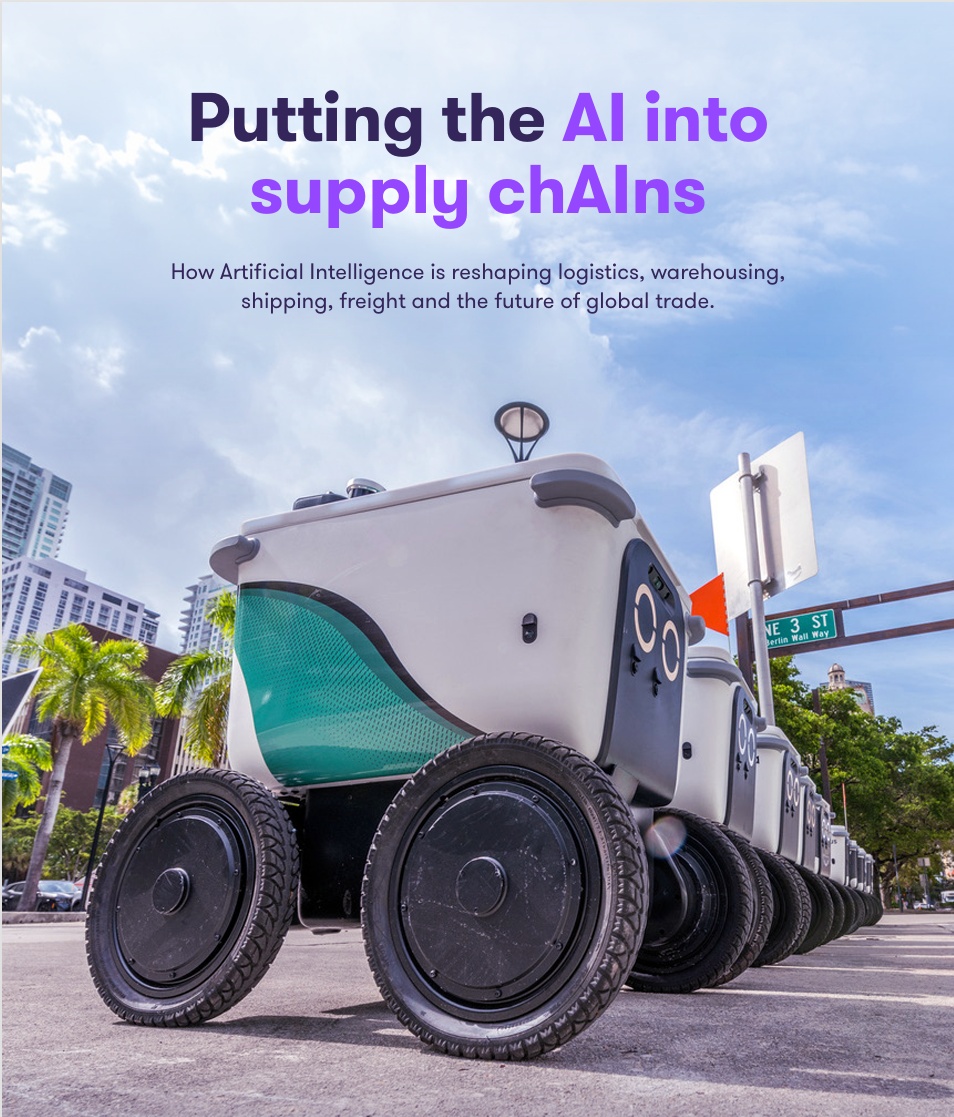
No turning back: Parcelhero report finds AI has already transformed the global supply chain
A new industry report, ‘Putting the AI into Supply ChAIns’, reveals there is a seismic shift under way in UK logistics. The new whitepaper, from international delivery specialist Parcelhero, examines how AI is reshaping every part of the supply chain, from warehouse floor to open sea. It reveals that the transformation is already too advanced and too broadly based for any logistics operator to ignore.
The new report, authored by Parcelhero’s head of consumer research David Jinks, states that the proportion of UK transport and storage firms using artificial intelligence leapt from 16.1% to 27.1% in the first three months of 2026 alone – an 11 percentage point surge in just 90 days. With over 20% of remaining firms planning to adopt AI within Q2, the first wave of adoption is far from complete.
David said, ‘The numbers uncovered in our latest industry report tell a remarkable story. Firms are no longer piloting or exploring AI – they are embedding it. Around 40% of supply chain organisations globally are now investing in generative AI, and Deloitte’s 2026 Retail Industry Global Outlook found that 41% of retailers plan to deploy AI within 12 months, specifically to improve supply chain visibility. The early movers are gaining measurable advantages that will make it very hard for slower adopters to close the gap.
‘The report documents transformative gains at every stage of the supply chain. In logistics, AI driven route optimisation is already delivering a 10% reduction in costs and a 15% improvement in on-time delivery rates. Algorithms can now reorder a sequence of over 100 delivery stops in seconds; processing live traffic, weather and customer preference data simultaneously, a capability that would have seemed implausible even five years ago.
‘The last mile, historically the most punishing leg of any delivery journey, accounting for over 53% of total shipping costs, is being fundamentally reimagined. Intelligent systems can now forecast shipment volumes for specific facilities with up to 95% accuracy, allowing logistics networks to pre-position stock before demand is even formally registered. AI use across last mile delivery has grown by 39% in the past year alone.
‘In warehousing, McKinsey reports that 56% of businesses have already integrated AI into at least one operational function. The result is a new generation of smart warehouses where autonomous mobile robots navigate dynamically rather than following fixed routes, predictive maintenance flags equipment failures before they cause costly downtime, and AI driven energy management systems reduce electricity consumption across large facilities in real time.
‘At sea, the scale of change is equally striking. The maritime AI market, valued at £4.13 billion in 2024, is projected to grow at a compound annual rate of 23% over the next five years. In 2025 alone, 420 organisations adopted maritime AI technologies, up from 276 the previous year. The ‘Yara Birkeland’, the world’s first fully electric and autonomous commercial container ship, has already completed over 250 voyages, replacing 40,000 diesel truck journeys annually on its Norwegian route.
‘AI in air freight has also taken off. A sector that once ran on spreadsheets and reactive problem solving is now driven by real time data and machine learning. AI is compressing tasks that once required specialist knowledge – such as rate comparisons, export classifications, customs documentation and ETA predictions – into automated workflows that take minutes rather than days. This enables operators to anticipate disruptions before they occur rather than scrambling to respond after the fact.
‘The picture is not without complications. Many firms are held back not by the technology itself but by what lies beneath it: legacy systems, batch processed data and manual workflows that are simply incompatible with the real time data flows that AI requires. Getting the foundations right is every bit as important as choosing the right AI tools. Only 16% of logistics and supply chain organisations say they are unlikely to adopt AI within five years, but the readiness gap is real and it needs to be addressed honestly.
‘On workforce fears, our analysis of the ONS data offers a note of reassurance: 31% of AI adopting transport and storage firms reported no change in headcount, while the number reporting definite job cuts was too small to register statistically. The more pressing challenge, the report argues, is reskilling rather than redundancy.
‘The question is no longer whether to put the AI into supply chains. It has already arrived. The supply chains that will lead their industries by 2030 are those investing in data quality, digital infrastructure and workforce capability today. The question is how quickly and how well companies respond. For many, the clock is already running.’
You can read the full new report here