Scania pioneers vehicle to grid through Megawatt Charging System for heavy transport
Scania has successfully demonstrated one of the world’s first vehicle to grid (V2G) implementations for heavy commercial vehicles using Megawatt Charging System (MCS), marking an important step towards integrating heavy electric transport into the wider energy system.
The innovative demonstration shows how battery electric trucks can do more than transport goods. Through bi-directional charging, trucks can also support the power grid by providing flexibility services such as peak shaving, grid balancing, and energy storage.
As the electrification of heavy transport accelerates, the need for flexibility in energy systems is increasing. Large scale charging of heavy vehicles places new demands on local grids and electricity infrastructure. At the same time, electric trucks represent significant mobile battery capacity that can be used when vehicles are parked.
Using bi-directional power transfer within depot operations can also improve the utilisation of local renewable energy generation such as solar power, while creating greater flexibility around grid connection and energy management.
‘Electric trucks will not only consume electricity, they can also become an active resource in the energy system,’ said Tobias Ejderhamn, global manager, transformation and new business, Scania. ‘This shift transforms the fleet operator’s role from solely providing transport services to also offering energy flexibility.’
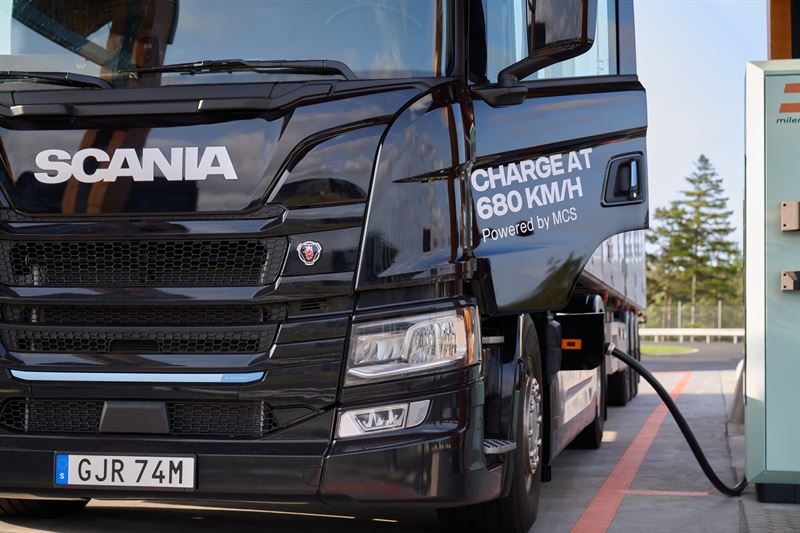
The demonstration was carried out using Megawatt Charging System (MCS), the new generation of ultra fast charging technology that is now being introduced for heavy electric trucks. MCS is expected to play a key role in enabling long distance electric transport and future energy services such as vehicle to grid.
The system enables secure real-time communication between the truck, the charger, and energy management systems. This allows charging and discharging to be dynamically controlled, based on transport needs and conditions in the power grid.
‘What makes this significant is not only the bi-directional energy flow itself, but the ability to combine megawatt charging with intelligent energy management,’ said Yorben Muller, product manager charging, Traton. ‘To our knowledge, this is one of the world’s first demonstrations of vehicle to grid functionality using MCS for heavy commercial vehicles. The truck, charger and energy system can communicate with each other in real time, creating the foundation for heavy electric vehicles to become active and controllable assets in the energy system.’
‘The ability to combine high power charging with intelligent and secure energy management could also strengthen the business case for battery electric trucks by creating new ways for fleet operators to optimise energy usage and lower their operational costs,’ added Tobias Ejderhamn.
The demonstrated solution supports:
- Bi-directional charging and discharging through MCS.
- Advanced real time communication between vehicle, charger and energy management systems.
- Back end controlled energy management.
- Integration with external charging and energy management systems.
- Bi-directional energy flow through the charging interface (known as EVSE).
By enabling trucks to interact with the energy system, fleet operators could:
- Reduce energy costs.
- Support grid stability.
- Optimise depot energy usage.
- Improve utilisation of local renewable electricity.
- Participate in future energy flexibility and balancing markets.
The technology also creates opportunities for charge point operators and energy providers by improving utilisation of charging infrastructure and local grid capacity.
By creating additional value streams around electric trucks and charging infrastructure, vehicle to grid technology also has the potential to support faster adoption of battery electric transport.
Initially, the technology is expected to be most relevant in depot charging environments where vehicles are parked for longer periods and charging can be coordinated with energy demand and grid conditions.